




This past week in therapy, PJ and I had to unpack a disagreement that left us distant for almost two days. It started one morning when I wanted to vent about something that was on my mind. PJ, being a morning person who likes to ease into her day quietly, wasn’t giving me her full attention. I, on the other hand, needed and wanted her full attention in that moment. When I didn’t get it, I went off. That frustration carried over, and we ended up not talking until our Thursday therapy session.
In that session, our therapist introduced us to the Gottman concept of “turning toward bids for connection.”
What Are Bids for Connection?
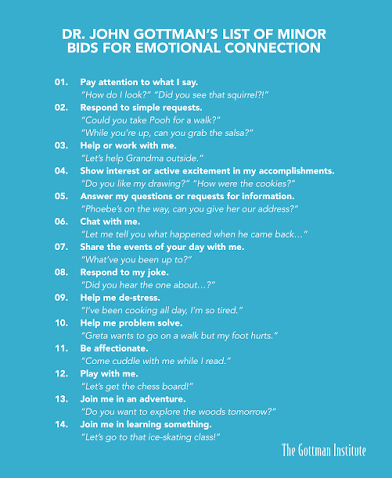
Dr. John and Julie Gottman describe bids as the small ways partners reach out for attention, affection, or support. A bid might be as obvious as saying, “Can we talk?” or as subtle as a sigh, a glance, or a joke meant to draw your partner in.
When a bid happens, the partner has three choices:
• Turn toward – respond with interest, attention, or support.
• Turn away – ignore or dismiss it.
• Turn against – respond with irritation or hostility.
Healthy relationships are built when partners consistently turn toward each other’s bids. Even the small ones matter because they add up and create a sense of security and love.
When I tried to vent that morning, I was really making a bid for connection. What I needed was for PJ to turn toward me by giving me eye contact, pausing for a moment, or even saying, “I want to hear this, but can we talk after I’ve had my coffee?” Instead, she couldn’t meet me where I was in that moment, and I took it as rejection. My reaction escalated things, and before we knew it, a small disconnect grew into almost two days of silence.
Our therapist helped us see that the issue wasn’t really about the venting. It was about how we were—or weren’t—responding to each other’s bids.
By the end of that session, PJ and I made a pact to leave that specific disagreement in therapy and not drag it back into our home. We also left with tools to make sure that when one of us makes a bid, the other doesn’t miss it.
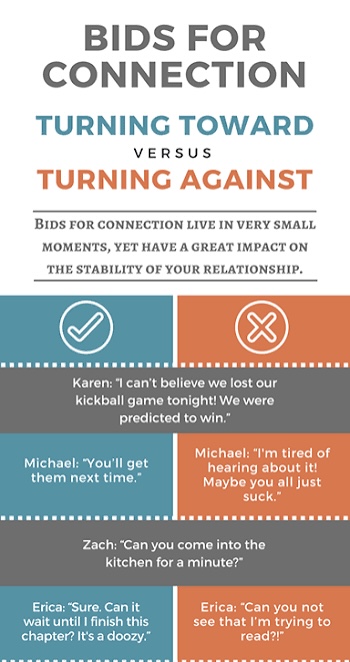
Here are a few examples of what this looks like:
• Bid: “I had such a stressful day at work.”
Turn Toward Response: Pause, make eye contact, and say, “Tell me what happened.”
• Bid: A partner sighs loudly while scrolling their phone.
Turn Toward Response: Ask, “What’s on your mind?” instead of ignoring it.
• Bid: “Look at this funny video!”
Turn Toward Response: Even if you’re busy, take 10 seconds to watch it together—it shows that their joy matters to you.
It’s not about always being perfect or dropping everything on the spot. It’s about acknowledging the bid, letting your partner know you see them and you care.
After therapy, PJ and I went out to dinner, and it felt good to be talking again. More importantly, it felt like we had turned a corner. We realized that these little bids for connection aren’t so little—they’re the glue that holds us together.
Now, we’re committed to paying closer attention. When either of us reaches out—whether it’s with words, a gesture, or even a sigh—the other will try to turn toward, not away. Because in the end, love is built on those everyday moments of saying, “I’m here, and I hear you.”
Until I decide to write again
Yours Truly,
Day