


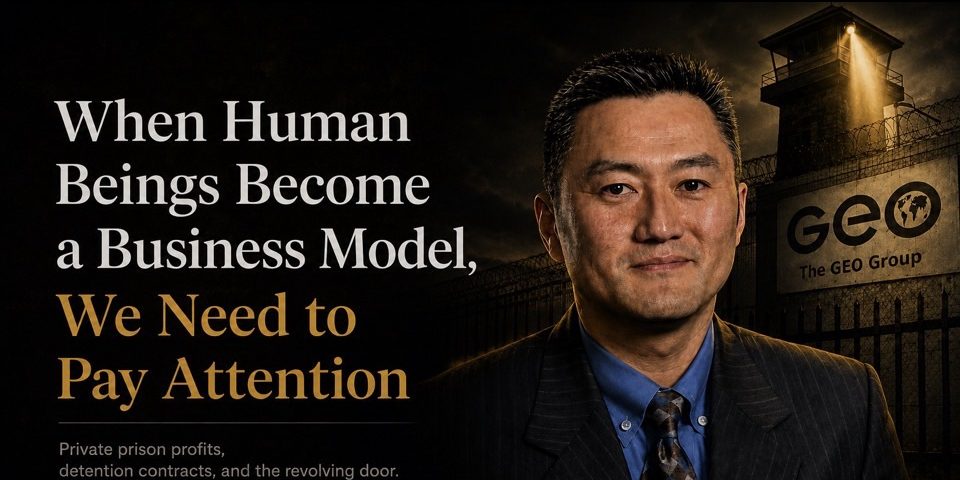
Some stories are not complicated because the facts are hard to understand. They are complicated because the people in power are hoping you get too tired to follow the money.
That is where we are with David Venturella and ICE.
David Venturella is expected to become acting director of U.S. Immigration and Customs Enforcement after Todd Lyons steps down at the end of May. Before this move, Venturella worked at GEO Group, one of the largest private prison and detention companies in the country. Reporting from Reuters and AP says Venturella later returned to ICE and led the agency’s detention contracts division after leaving GEO in 2023.
Let me say that in plain English.
A man who worked for a company that profits from detention then moved into a government role overseeing detention contracts. Now he is being elevated to lead the entire agency.
And somehow, we are all supposed to act like this is just a normal Tuesday in Washington.
No ma’am.
This is why people are sounding the alarm. This is not some small personnel shuffle that only matters to policy insiders, immigration attorneys, or people who read government memos for fun. This is the kind of appointment that shows us how power really works when nobody thinks regular people are paying attention.
GEO Group makes money from detention contracts. ICE is one of the most important clients in that world. GEO told investors on May 6 that it had $705.2 million in first-quarter 2026 revenue, up 17 percent from the year before, and that its net income attributable to GEO operations rose 96 percent to $38.3 million. The company also said new or expanded contracts from 2025 represented up to about $520 million in new incremental annualized revenue, the largest amount of new business it had won in a single year.
That is not activist language. That is investor language.
That is the money talking.
And when the money starts talking around cages, beds, contracts, transportation, detention capacity, and government expansion, we need to stop pretending this is only about “law and order.”
Because this is also about profit.
GEO’s own investor materials said that in its secure services segment, it entered into new contracts to house ICE detainees at four facilities totaling roughly 6,000 beds. The company said those activations, along with the reactivation of its Adelanto ICE Processing Center in California, represent annualized revenue of approximately $300 million.
On the company’s earnings call, GEO also described having about 6,000 idle beds at six company-owned facilities, many of them former U.S. Bureau of Prisons facilities. The company said those beds could generate more than $300 million in combined incremental revenue at full capacity.
Read that again.
Idle beds.
Full capacity.
Incremental revenue.
This is the language of a business model.
But the “beds” are not just beds. They are human beings. They are mothers. Fathers. Workers. Children’s parents. Neighbors. People with court dates. People with families waiting for them. People who may not have been convicted of any crime. People whose bodies become part of somebody else’s revenue projection.
That is what makes this so ugly.
Because when detention becomes a growth strategy, there is an incentive to fill the beds.
And once there is an incentive to fill the beds, everything else becomes dangerous.
The raids become dangerous.
The policies become dangerous.
The contracts become dangerous.
The political speeches become dangerous.
The budget requests become dangerous.
The people making decisions become dangerous when they are too close to the companies positioned to profit from those decisions.
That is why conflict-of-interest concerns matter.
This is not about one man’s résumé in isolation. It is about a revolving door that keeps spinning between private companies and public power. It is about people moving from companies that profit off government detention into government roles that influence the size, shape, and direction of detention itself.
And the public is supposed to trust that everything is fine because somebody signed a waiver or followed the technical rules.
I am sorry, but “technically allowed” is not the same thing as “ethically clean.”
Washington loves to hide behind process.
They will say the paperwork was filed.
They will say the rules were reviewed.
They will say there are ethics agreements.
They will say the person is experienced.
They will say this is about operational knowledge.
They will say all the things people say when they want us to look at the résumé and ignore the power structure.
But we are grown.
We can see what this is.
When someone comes from the private detention industry, then helps oversee detention contracts, then moves into the top role at the federal agency responsible for detention enforcement, people have every right to ask who benefits.
And no, asking that question is not radical.
It is basic accountability.
Because public policy should not be shaped by private profit.
Human freedom should not be tied to shareholder value.
Immigration enforcement should not become a business development plan.
And human beings should never, ever be treated like a growth strategy.
This is where people need to understand the deeper issue. The private prison and detention industry does not just sit quietly in the background waiting for government policy to happen. These companies watch political winds. They watch budgets. They watch enforcement priorities. They watch elections. They talk to investors. They plan around expansion. They prepare facilities. They count beds.
And when the government decides to increase detention, somebody is ready to cash the check.
That is why “follow the money” is not just a cute phrase. It is survival politics.
If a company tells investors that more detention capacity can mean hundreds of millions of dollars in revenue, then we need to ask what happens when the people running detention policy have deep ties to that same industry.
What happens to due process?
What happens to oversight?
What happens to medical care?
What happens to families?
What happens to people held far from legal support?
What happens to communities when enforcement becomes a pipeline and detention becomes the destination?
What happens when a corporation looks at human confinement and sees opportunity?
None of those questions are dramatic. They are necessary.
And I know there are people who will say, “Well, if people did not break the law, they would not be detained.”
That line is always used to shut down the conversation before we get to the truth.
The truth is that immigration detention is a civil system, not the same thing as a criminal sentence. Many people in detention are waiting for hearings, fighting removal, seeking protection, or navigating a legal process that can be confusing even for people with money, lawyers, and English as a first language.
So let’s not flatten this into some simple “criminals versus citizens” talking point.
That is what politicians do when they want people scared instead of informed.
Because fear makes it easier to expand power.
Fear makes it easier to build cages.
Fear makes it easier to hand contracts to private companies.
Fear makes it easier for the public to stop asking questions about money.
And baby, the money is the part they do not want us staring at for too long.
GEO’s first-quarter 2026 report did not sound like a company suffering. It sounded like a company looking at expansion, increased guidance, newly activated facilities, transportation services, and more revenue opportunities connected to government contracts. The company raised its full-year 2026 revenue guidance to between $2.95 billion and $3.10 billion.
That is the part people need to sit with.
While families are terrified, investors are calculating upside.
While people are being detained, companies are talking about capacity.
While communities are asking where their loved ones were taken, corporations are talking about annualized revenue.
That is not normal.
Or maybe it is normal, and that is exactly the problem.
Because America has always had a nasty little habit of turning human suffering into somebody else’s business opportunity.
We have seen this country profit from stolen labor.
We have seen it profit from segregation.
We have seen it profit from mass incarceration.
We have seen it profit from surveillance, policing, punishment, poverty, and fear.
So when people say, “This is just how the system works,” my answer is: exactly.
That is the indictment.
The system works this way because too many people benefit from it working this way.
And when enough people benefit, cruelty starts getting dressed up as policy.
It gets a budget line.
It gets a contract.
It gets a press release.
It gets an earnings call.
It gets normalized.
Then, if anyone objects, they are told they are being emotional, political, unrealistic, or soft on enforcement.
But there is nothing soft about refusing to let human beings be reduced to occupancy rates.
There is nothing unrealistic about saying government power needs public oversight.
There is nothing emotional about asking whether people with industry ties should be in charge of decisions that benefit that industry.
That is not softness.
That is common sense.
And let’s talk about the acting director part too.
ICE has not had a Senate-confirmed director since 2017, according to reporting on Venturella’s appointment. That means the agency has been operating for years under acting leadership.
That matters because acting officials can hold enormous power without the same level of public confirmation scrutiny. When the agency is already controversial, already powerful, and already tied to major questions about detention, force, civil rights, and public money, leadership should not feel like a backroom relay race.
The public deserves scrutiny.
The public deserves transparency.
The public deserves to know whether private profit is shaping public enforcement.
And the public deserves more than “trust us.”
Because trust is not a substitute for accountability.
The scary thing about the revolving door is not just that people move between industry and government. It is that their worldview moves with them.
If you spend years inside a company that sees detention as a service to be sold, what assumptions do you bring into government?
If you spend years thinking in terms of beds, capacity, contracts, cost, expansion, and revenue, how do you then make decisions about people whose freedom depends on those systems?
If you helped oversee contracts after leaving the company that benefits from those contracts, what guardrails are strong enough to convince the public this is not contaminated by conflict?
These are not personal attacks.
These are governance questions.
And if the people in charge cannot handle those questions, they should not be in charge.
The bigger picture is simple: we cannot separate immigration policy from capitalism, private contracting, and political power.
We cannot talk about raids without talking about detention beds.
We cannot talk about detention beds without talking about contracts.
We cannot talk about contracts without talking about the companies that profit.
We cannot talk about those companies without talking about the people moving between corporate boardrooms and government offices.
That is the whole machine.
And if we only argue about the loudest political talking points, we miss the machinery underneath.
That is why we have to pay attention to appointments like this.
Not because one appointment tells the whole story, but because it reveals the pattern.
A company profits from detention.
A former company executive moves into government detention work.
The government expands detention.
The company reports major revenue opportunities.
That person rises to lead the agency.
And we are supposed to believe this is all just coincidence?
No.
At some point, “coincidence” becomes a business plan.
I want people to stop treating these stories like they are too complicated to care about. They are not.
If your tax dollars are paying for detention, you should care.
If your government is giving contracts to private companies, you should care.
If human beings are being held in facilities where corporations profit from capacity, you should care.
If people with private industry ties are moving into public enforcement roles, you should care.
If the language of immigration policy starts sounding like an investor presentation, you should care.
Because once the government and private profit get too comfortable together, ordinary people are usually the ones who pay the price.
And in this case, the price is not just money.
The price is freedom.
The price is family separation.
The price is fear.
The price is communities being terrorized.
The price is due process being treated like an inconvenience.
The price is human beings becoming numbers in somebody’s quarterly growth strategy.
That should disturb everybody.
Not just immigrants.
Not just Black and brown people.
Not just activists.
Everybody.
Because a government that can build profit systems around one group’s confinement can always expand the logic later.
History has taught us that over and over again.
The main takeaway is this: when private companies make money from detention, and people connected to those companies move into positions of public power over detention, we have a responsibility to ask hard questions.
Not polite questions.
Hard questions.
Who profits?
Who decides?
Who gets detained?
Who gets paid?
Who is watching the contracts?
Who is enforcing ethics rules?
Who is protecting the people inside these facilities?
Who is making sure human lives are not being sacrificed for corporate growth?
Because that is what this comes down to.
Human beings should never be a growth strategy.
Pay attention to who profits.
Pay attention to who gets appointed.
Pay attention to the contracts.
Pay attention to the language.
Pay attention when they call people “beds.”
Pay attention when a company celebrates revenue while communities are counting the missing.
Pay attention before the machinery gets so loud that people forget there are human beings trapped inside it.
Let’s Talk
When private companies profit from detention, can the government ever truly make humane policy, or is the conflict already baked into the system? I want to hear what you think in the comments.