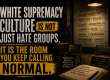



White privilege is one of those phrases that makes some people act like you just walked into their house, kicked over the coffee table, and accused their grandma of a federal crime.
Let’s talk about that.
Because every single time somebody says “white privilege,” there is a whole crowd of white folks who immediately start reaching for their personal hardship résumé.
“I grew up poor.”
“My parents struggled.”
“Nobody gave me anything.”
“I worked hard for everything I have.”
“I had trauma too.”
And listen, all of that can be true.
You can be white and have suffered. You can be white and have grown up broke. You can be white and have had a hard life. You can be white and have had to fight your way through pain, loss, abuse, addiction, disability, grief, or generational struggle.
White privilege does not mean your life has been easy.
It means your race was not one of the things making your life harder.
That is the part too many people refuse to sit with.
Not because they do not understand the words. I think a lot of folks understand just fine. They just do not like what those words ask them to confront.
Because once you admit privilege exists, you also have to ask yourself what you have been doing with it.
And baby, that is where the room gets quiet.
The first thing we need to clear up is this: white privilege is not me calling you a bad person.
It is not me saying you asked for it. It is not me saying you personally created every system in this country. It is not me saying you have never struggled. It is not me saying every white person is rich, happy, protected, or living some soft little life with sunshine and good credit.
That is not what it means.
White privilege means that in a society built around whiteness, white people receive certain benefits, assumptions, protections, and access that people of color do not automatically receive.
It is the benefit of being seen as the default.
It is being treated as an individual instead of a stereotype.
It is being believed more quickly.
It is walking into a store and not being followed because someone decided your skin looked suspicious.
It is driving through certain neighborhoods without your presence being treated like a crime scene waiting to happen.
It is speaking up at work and being called “passionate” while a Black woman saying the same thing gets labeled “aggressive.”
It is making a mistake and being treated like a person who made a mistake, not a reflection of your entire race.
That is privilege.
Not perfection. Not immunity from hardship. Not a guarantee of success.
Privilege.
One reason so many white people miss white privilege is because privilege often feels normal to the people who have it.
If a door has always opened for you, you may not notice who is being kept out.
If people have always assumed you belong in the room, you may not notice who gets questioned before they even sit down.
If your name, your hair, your tone, your skin, your culture, your neighborhood, your family structure, and your presence have always been treated as “normal,” you may not realize how exhausting it is to live in a country where you are constantly being measured against whiteness.
That is how systems work.
They do not have to announce themselves every morning.
They just show up as “the way things are.”
That is why people can benefit from white privilege without ever consciously asking for it. It is baked into housing. Schools. Policing. Medical care. Hiring. Media. Politics. Beauty standards. Banking. Neighborhood surveillance. The criminal legal system. Who gets grace. Who gets the benefit of the doubt. Who gets protected. Who gets punished. Who gets called a threat before they even open their mouth.
And the wild part is, so much of this is treated like it is invisible.
But it is not invisible to us.
Black and brown people see it every day.
We see who gets patience and who gets suspicion.
We see who gets “boys will be boys” and who gets handcuffs.
We see who gets mental health language and who gets criminalized.
We see who gets second chances and who gets made into an example.
We see who gets to be complicated and who gets flattened into a stereotype.
So when people of color talk about white privilege, we are not making it up because we are bitter. We are naming what we have had to survive.
One of the most common responses to conversations about white privilege is, “Well, I treat everyone the same.”
And I need people to understand that this is not the powerful statement they think it is.
Because treating everyone “the same” in an unequal society can still reproduce inequality.
If two people are standing at different starting lines and you say, “I gave them both the same instructions,” that does not make the race fair.
If one person has been carrying the weight of discrimination, suspicion, underfunded schools, generational exclusion, medical neglect, over-policing, and workplace bias, and another person has not, then pretending they are both moving through the same conditions is not fairness.
It is avoidance.
And let’s be honest: a lot of people say “I treat everyone the same” because it gives them a way to avoid doing deeper work.
It sounds clean. It sounds neutral. It sounds nice.
But justice is not always neutral.
Sometimes justice requires you to notice who has been harmed.
Sometimes justice requires you to notice who has been excluded.
Sometimes justice requires you to ask why certain people keep getting the benefit of the doubt while others keep getting the burden of proof.
So no, “I treat everyone the same” is not enough.
Because the system does not treat everyone the same.
And if you are not actively interrupting that, you may be quietly helping it continue.
Now let’s talk about the defensiveness.
Because when conversations about white privilege come up, some white folks go straight into emotional lockdown.
They get offended. They get loud. They get hurt. They get sarcastic. They get fragile. They get personal.
Instead of listening, they start explaining why the conversation should be softer, nicer, more comfortable, more balanced, more polite, more patient, more “productive.”
And what they really mean is: “Can you talk about oppression in a way that does not make me feel implicated?”
No.
Because accountability is not supposed to feel like a spa day.
Growth is uncomfortable. Unlearning is uncomfortable. Being corrected is uncomfortable. Realizing you have benefited from something unjust is uncomfortable.
But discomfort is not harm.
Too many people confuse being uncomfortable with being attacked.
You are not being attacked because someone says white privilege exists.
You are being invited to stop pretending it does not.
That is the difference.
And guilt is not the goal.
I do not need white guilt. I do not need a long apology tour. I do not need somebody crying in the corner while Black people are still doing all the labor.
Guilt can become another form of centering yourself.
Accountability is different.
Accountability asks: What will I do now? What will I interrupt? What will I risk? Who will I challenge? What will I stop excusing? Where will I use my access? Where will I stop being silent?
That is where the work begins.
A lot of people love calling themselves allies.
And to be clear, I am not against allyship when it is real. But too often, “ally” has become a comfortable identity instead of a committed practice.
Allyship says, “I care.”
Accomplice work says, “I will risk comfort to challenge the system.”
There is a difference.
An ally may share the post.
An accomplice speaks up in the room where the harm is happening.
An ally may say, “That is terrible.”
An accomplice asks, “What are we going to do about it?”
An ally may privately agree with you.
An accomplice publicly interrupts the lie.
An ally may love Black culture.
An accomplice protects Black people.
An ally may read the book.
An accomplice changes the policy.
An ally may show up when it is popular.
An accomplice shows up when there is a cost.
That cost might be social. That cost might be professional. That cost might be relational. That cost might be losing approval from people who benefit from your silence.
But if your anti-racism disappears the moment it becomes inconvenient, then what you had was not commitment. It was branding.
And we have enough branding.
We need action.
White privilege is not only about the big dramatic moments. Sometimes it is quiet. Sometimes it is ordinary. Sometimes it is so routine that people miss it entirely.
It can show up when a white person is late and people assume there must be a reason, while a Black person is late and people assume irresponsibility.
It can show up when a white parent advocates hard for their child and gets called involved, while a Black parent doing the same thing gets treated as difficult.
It can show up when a white person questions authority and gets called engaged, while a Black person questions authority and gets labeled disrespectful.
It can show up when a white employee is allowed to “grow into” leadership, while a Black employee has to be overqualified just to be considered.
It can show up when white pain is humanized and Black pain is debated.
It can show up when white fear becomes policy and Black fear gets dismissed.
It can show up when missing white women become national stories and missing Black women barely become local news.
It can show up when white people are shocked by systems Black people have been warning about for generations.
That is the thing about privilege. It does not always look like someone handing you a bag of money.
Sometimes it looks like not having to think about something that other people have to think about every single day.
At some point, the conversation has to move beyond denial.
Because whether someone wants to admit it or not, white privilege exists.
The real question is: what are you doing with it?
Are you using it to make yourself comfortable?
Or are you using it to challenge the systems that keep other people unsafe, unheard, underpaid, over-policed, underprotected, and exhausted?
Are you speaking up only when Black people are in the room?
Or are you saying something when nobody is watching?
Are you reposting quotes about justice?
Or are you interrupting injustice when it shows up in your family group chat, your workplace, your school board meeting, your church, your book club, your neighborhood, your voting choices, and your everyday decisions?
Because let’s be clear: white privilege does not disappear because you are nice.
It does not disappear because you have Black friends.
It does not disappear because you voted the “right” way once.
It does not disappear because you read a book, watched a documentary, posted a black square, or told yourself you are one of the good ones.
The work is daily.
And it is not about perfection.
It is about practice.
If you are white and reading this, the goal is not for you to spiral into shame.
The goal is for you to pay attention.
Notice who is centered.
Notice who is missing.
Notice whose voice is treated as credible.
Notice whose anger is punished.
Notice whose fear is protected.
Notice whose mistakes are forgiven.
Notice whose history is erased.
Notice whose pain has to be proven over and over again.
Then ask yourself the real question:
What can I say or do right now?
Not next year. Not when it is easier. Not when everybody agrees. Not when there is no risk. Not when you have figured out the perfect language.
Right now.
Because awareness without action is just observation.
And people of color do not need more white observers.
We need people willing to interrupt harm.
We need people willing to challenge the lie.
We need people willing to use the access they have to open doors, change rooms, question policies, protect people, redistribute power, and stop making Black and brown people carry the entire burden of fighting systems we did not create.
White privilege is not about whether your life has been hard.
It is about whether your race has been one of the reasons it was harder.
And for white people in this country, the answer is no.
That does not make you evil.
But denying it does make you dangerous.
Because denial protects the system.
Defensiveness protects the system.
Silence protects the system.
Performative allyship protects the system.
And if you are benefiting from a system while refusing to confront it, then you are not neutral.
You are participating.
So yes, dear white people, let’s talk about white privilege.
Not to shame you.
Not to center you.
Not to make you perform guilt.
But because if we are ever going to build something better, people with access have to stop pretending they do not have it.
Awareness is the beginning.
Action is the work.
Now the question is: what are you going to do with what you know?
Let’s Talk
What is one everyday example of white privilege that people still try to deny, excuse, or explain away? Drop your thoughts in the comments, especially if you have seen it happen in real time.