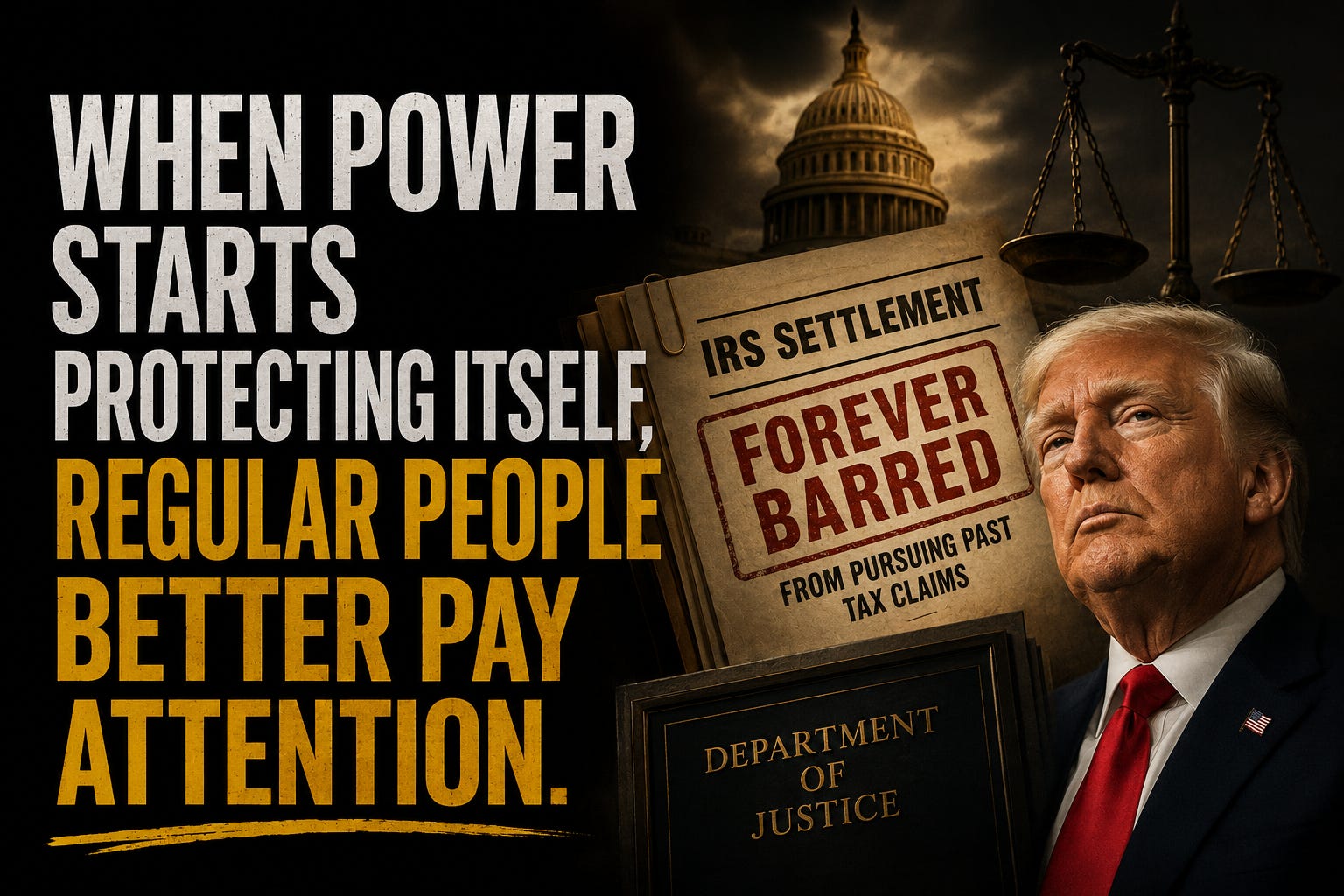


Some stories are not just about taxes. Some stories are about power looking at accountability and saying, “Not today, not tomorrow, not ever.”
That is what this Trump and IRS settlement feels like.
Because let’s be real. If a regular person owed the IRS money, missed filings, had questionable deductions, or found themselves under a serious tax review, nobody in the federal government would rush in with a golden shield and say, “Do not worry, beloved citizen, we are forever barred from bothering you again.”
Please.
Regular people get letters. Regular people get penalties. Regular people get wage garnishments. Regular people get payment plans that feel like a second rent bill. Regular people get told that confusion is not an excuse, hardship is not an excuse, and “I did not know” is definitely not an excuse.
But Donald Trump?
He just got something ordinary people would never even know how to ask for.
According to reporting from Reuters, the Justice Department released a one-page document signed by Acting Attorney General Todd Blanche that says the U.S. government is “forever barred” from pursuing audits into past tax claims involving Trump, his relatives, and his companies for returns filed before May 18, 2026, including matters that were raised or could have been raised.
That is not a pause.
That is not a scheduling delay.
That is not “we will revisit this later.”
That is permanent protection.
And before anyone starts pretending this is some ordinary legal housekeeping, let’s walk through what happened.
Trump filed a $10 billion lawsuit against the IRS and Treasury Department over the leak of his tax records. CBS News reported that the lawsuit accused the agencies of allowing an IRS contractor to improperly disclose tax records connected to Trump, his sons, and the Trump Organization.
Then the Justice Department settled the case.
As part of that settlement, CBS News reported that Trump, Don Jr., Eric Trump, and the Trump Organization would receive a formal apology, but no direct monetary damages. Instead, the deal created a $1.776 billion “Anti-Weaponization Fund” for people who claim they were harmed by political weaponization or lawfare.
So let me get this straight.
A sitting president sued the IRS and Treasury Department. His own Justice Department settled the lawsuit. Then, after that settlement, a document appeared saying the federal government was forever barred from going after certain past tax claims tied to him, his family, and his businesses.
And we are supposed to look at that and say, “Nothing to see here?”
No ma’am.
That is exactly when we should be looking harder.
Because this is bigger than tax paperwork. This is about what happens when public power starts bending itself around one powerful man.
And I want people to understand why this matters beyond whether you like Trump or hate Trump.
This is about whether the government is supposed to apply the law equally, or whether the most powerful people in the country get to turn government agencies into their personal legal cleanup crew.
Because regular people do not get a forever shield.
Small business owners do not get a forever shield.
Single mothers do not get a forever shield.
Workers who accidentally underpaid do not get a forever shield.
Retirees who made a paperwork mistake do not get a forever shield.
But somehow, this settlement created language so sweeping that the federal government agreed it would not pursue certain past tax matters involving Trump, his family, and his business interests.
That is not justice.
That is power protecting power.
And it hits differently because this was not some agreement between two truly separate forces with equal distance from each other. Trump was not just some private citizen suing an outside government. He was president while the Justice Department, which is part of his administration, settled the case.
That matters.
The Associated Press reported through The Washington Post that the U.S. government agreed to permanently drop tax claims against Trump as part of the broader settlement of his $10 billion lawsuit over the leak of his tax returns. The report also noted that the one-page document was posted to the Justice Department website and said the U.S. was “forever barred and precluded” from examining or prosecuting Trump, his sons, and the Trump Organization’s current tax issues.
That phrase should stop people in their tracks.
Forever barred and precluded.
That sounds like the kind of language rich and powerful people get when the system has decided the door is closed and nobody else gets to knock.
And that is the problem.
The IRS is supposed to enforce tax law. It is not supposed to become a shield for the politically powerful. It is not supposed to be used as a weapon against enemies, and it is also not supposed to be disarmed when the person being examined has enough power to make the discomfort go away.
Both things can be true.
Government agencies should not leak private tax records. That is serious. People’s confidential tax information should not be stolen, leaked, or used for political embarrassment. The former IRS contractor connected to the leak, Charles Littlejohn, was sentenced in 2024 to five years in prison after pleading guilty in a case involving the disclosure of tax records, according to earlier reporting from The Washington Post.
That part matters.
But accountability for a leak should not become a blank check for permanent immunity from tax scrutiny.
That is where the alarm bells start ringing.
Because when one harm gets used to justify an extraordinary protection, we need to ask who else would get the same treatment.
If a Black small business owner’s tax information was leaked, would they get a nearly $1.8 billion fund created around their claim?
If an immigrant family’s records were mishandled, would the federal government apologize and permanently bar future tax action tied to the past?
If a teacher, nurse, retiree, truck driver, or single parent said they felt targeted by the IRS, would the government build an entire legal escape hatch?
We know the answer.
That is what makes this so insulting.
The law is supposed to be blind, but somehow it always seems to have perfect vision when regular people are standing in front of it. It sees every mistake. Every missing form. Every dollar. Every late payment. Every technicality.
But when the powerful show up, suddenly the law needs nuance. Suddenly there are special circumstances. Suddenly the paperwork gets creative. Suddenly the language becomes sweeping. Suddenly “forever barred” appears on a government document like this is normal.
It is not normal.
Or maybe it is normal, and that is exactly the problem.
Because this country has always had two justice systems. One for people who have to explain themselves, and one for people who have enough money and power to make the system explain itself to them.
This settlement is not just about one case. It is about the message it sends.
The message is that if you are powerful enough, even the agency responsible for enforcing tax law can be boxed out.
The message is that the Justice Department can help close the door on scrutiny involving the same person sitting at the top of the executive branch.
The message is that ordinary people are expected to comply, while powerful people negotiate the rules of accountability itself.
And then there is the fund.
The Anti-Weaponization Fund is almost too perfect as a political phrase. It sounds official. It sounds righteous. It sounds like it was designed in a lab for cable news.
But the details raise serious questions.
CBS News reported the fund would be $1.776 billion and would provide a process for people who say they suffered from weaponization and lawfare. The Guardian reported that critics have questioned the fund’s structure, including concerns over transparency, who can apply, and how it will be managed.
So now we are not only talking about Trump getting a formal apology and a broad tax protection. We are talking about a massive fund created through a settlement tied to his lawsuit, with political allies potentially positioned to claim harm from past investigations or prosecutions.
That is not just a legal story.
That is a power story.
That is a money story.
That is a democracy story.
Because whenever the government starts creating special lanes for the powerful, the rest of us should be asking who gets left standing in the regular line.
And let’s not miss the timing.
The settlement ended Trump’s $10 billion lawsuit. Then, according to Axios, the terms were expanded with a waiver that permanently barred the IRS from pursuing tax-related claims tied to past issues involving him or affiliated individuals. Axios also noted that the expanded waiver was not part of the initial agreement and raised controversy because federal officials, including the president, typically cannot simply prevent IRS investigations under ordinary circumstances.
That is the kind of detail that makes this even more troubling.
Because it is one thing to settle a lawsuit over a leak.
It is another thing to use that settlement to shut down future action over past tax matters.
That is a much bigger deal.
It turns a privacy violation case into a shield.
And when power creates a shield for itself, people have every right to question the system.
I can already hear some folks saying, “Well, he was wronged. His tax records were leaked.”
Yes. Leaking private tax records is wrong.
But let’s not pretend that being wronged in one way means you should become untouchable in every other way.
That is not how accountability works.
If someone violates your privacy, they should be held accountable.
But that does not mean the government should be blocked from enforcing tax law around prior issues that could have been examined or prosecuted.
Those are two different things.
And powerful people love when we confuse two different things.
They want us arguing about whether the leak was wrong so we do not ask why the remedy became so extreme.
They want us focused on the emotional language of “weaponization” so we do not read the fine print.
They want us treating this like a partisan food fight instead of a public accountability crisis.
But the fine print is the story.
The fine print is where power hides.
The fine print is where regular people get trapped and rich people get protected.
And that is why this matters.
Because if this can happen here, then what stops future presidents, cabinet officials, billionaires, or politically connected families from turning lawsuits into protection agreements?
What stops public agencies from becoming bargaining chips?
What stops government power from being used to erase government scrutiny?
What stops the powerful from saying, “We are the government, and we have decided the government can no longer question us”?
That should scare people.
Not because of party.
Because of precedent.
The IRS is not popular. I get that. Nobody wakes up excited to hear from the IRS. Nobody sees an envelope from them and says, “Oh good, a little afternoon joy.”
But the point of tax enforcement is supposed to be that everyone who owes must answer.
The wealthy.
The connected.
The business owner.
The worker.
The politician.
The president.
Everybody.
When that standard starts breaking, the burden does not disappear. It shifts.
And it usually shifts downward.
When powerful people avoid scrutiny, regular people pay in other ways. We pay through underfunded services. We pay through budget cuts. We pay through austerity. We pay through the lie that there is never enough money for schools, housing, healthcare, childcare, infrastructure, or the communities that need investment the most.
There is always enough creativity to protect the powerful.
There is always enough urgency to shield the connected.
There is always enough legal imagination to rescue the people who already have the most.
But when regular people need relief, suddenly everybody becomes a constitutional scholar, a deficit hawk, and a paperwork expert.
That is the game.
And it is exhausting.
This is why people are angry.
Not because they do not understand that tax records should be private.
Not because they think leaks are fine.
Not because they hate due process.
People are angry because they recognize special treatment when they see it.
They know what would happen to them.
They know the government would not write them a forever shield.
They know no one would create a billion-dollar fund because they felt targeted.
They know no one would bend over backwards to protect their family business.
They know accountability is not applied equally in this country.
And this settlement just put that inequality in writing.
The bottom line is simple.
Regular people do not get a forever shield.
The IRS is supposed to enforce tax law, not carry out lasting protection for the powerful.
Trump just got a deal that permanently blocks future action over past tax issues involving him, his family, and his businesses.
And yes, people should be paying attention.
Because this is not just about taxes.
This is about what happens when power stops fearing accountability.
This is about what happens when the government starts protecting itself.
This is about what happens when one man’s legal problems become the public’s democratic problem.
And if we do not call it out clearly, they will treat the silence as permission.
Let’s Talk
Do you think any president should be able to settle a lawsuit with their own Justice Department in a way that permanently blocks the IRS from pursuing past tax claims? Drop your thoughts in the comments, because this one deserves a real conversation.
Thanks for reading. If this piece moved you or made you think, please consider becoming a subscriber.