


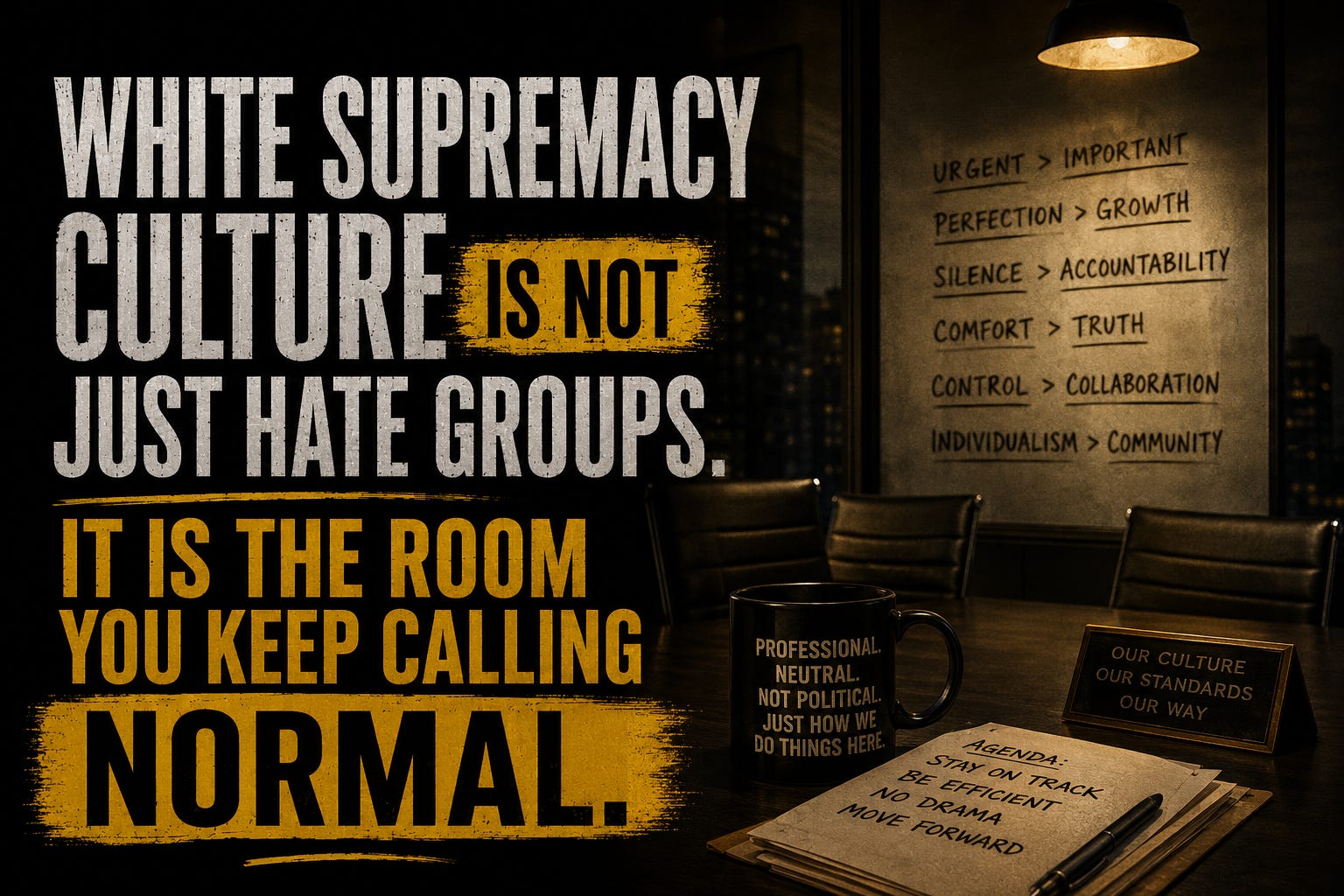
White supremacy culture is sneaky because too many people only know how to recognize it when it is wearing a hood, carrying a flag, yelling a slur, or standing in the middle of some obvious hate rally acting like history did not already embarrass them enough.
But white supremacy culture is not just the loud, ugly, obvious stuff.
That is the easy part to condemn.
Most people know how to say, “I am against hate groups.” Most people know how to shake their heads at the Proud Boys, the Klan, or some man in a tactical vest screaming about taking his country back. That part does not require much courage. That is the part people can reject publicly without losing much.
The harder part is looking at the everyday habits that keep unequal power protected while everybody insists they are just being “professional,” “efficient,” “neutral,” “organized,” or “reasonable.”
That is where the real conversation begins.
Because white supremacy culture is not only about individual hate. It is also about systems, habits, standards, expectations, and power dynamics that treat one way of being as normal, smart, professional, and correct while making everyone else adapt, shrink, explain, code-switch, overperform, or stay silent just to be taken seriously.
And this is why it can feel invisible to the people who benefit from it.
If the culture was built around you, it feels like common sense.
If the workplace rewards your tone, it feels like professionalism.
If the school system reflects your history, it feels like education.
If the meeting style matches how you were taught to speak, it feels like order.
If your comfort is treated as the emotional temperature of the room, it feels like fairness.
But for Black people and people of color, we know the difference between a neutral room and a room that demands we leave pieces of ourselves at the door.
We know when urgency is being used to silence questions.
We know when perfectionism is being used to punish mistakes that white folks get to “learn from.”
We know when “professionalism” really means “make whiteness comfortable.”
We know when silence is being rewarded because truth would make the powerful uncomfortable.
We know when “collaboration” is just control wearing better shoes.
And baby, we definitely know when individualism is being used to avoid community responsibility.
This is the part people do not want to talk about because it moves the conversation out of the cartoon version of white supremacy and into the everyday rooms where people like to think they are good, nice, progressive, inclusive, and “not like that.”
But culture is not only what people say they believe.
Culture is what gets rewarded.
Culture is what gets punished.
Culture is what gets called normal.
Culture is who gets protected when harm happens.
Culture is who gets told to be patient.
Culture is who gets told they are too angry, too emotional, too direct, too difficult, too negative, too sensitive, too loud, too much.
Culture is who gets to make mistakes and who gets made into an example.
And once you start looking at it that way, you begin to see white supremacy culture everywhere.
You see it in workplaces where everything is urgent until someone asks for equity.
Suddenly, there is no time to slow down and think. No time to ask who is being harmed. No time to bring more people into the conversation. No time to check whether the decision will land differently on the people with the least power.
But somehow there is always time to protect leadership.
There is always time to polish the statement.
There is always time to manage the optics.
There is always time to make sure the person who caused harm does not feel too uncomfortable.
That is not urgency.
That is power moving fast so accountability cannot catch up.
You see it in perfectionism, too.
Perfectionism sounds harmless because people dress it up as “high standards.” And listen, nobody is saying we should not care about doing things well. I love excellence. Black women especially know excellence because most of us were raised knowing we had to be twice as good just to get half the respect.
But perfectionism becomes harmful when it punishes honesty, vulnerability, growth, and experimentation.
It becomes harmful when people are afraid to admit mistakes.
It becomes harmful when Black people and people of color have to be flawless while white colleagues are allowed to be “still learning.”
It becomes harmful when the fear of saying the wrong thing becomes an excuse to say nothing.
It becomes harmful when institutions demand polished language but refuse to fix ugly behavior.
Because let’s tell the truth. Some of the most polished rooms in America are also some of the most harmful.
The email is polished.
The meeting agenda is polished.
The diversity statement is polished.
The apology is polished.
The website is polished.
Meanwhile, the culture is rotten.
And if you are more committed to looking good than doing right, you are not practicing accountability. You are practicing image management.
Then there is silence.
Silence is one of the most protected habits in white supremacy culture because silence allows people to keep their hands clean while harm continues.
Silence lets people say, “Well, I did not do anything.”
Exactly.
That is the problem.
You did not do anything.
You sat in the meeting when someone was dismissed.
You watched the Black woman get labeled aggressive for saying what the white man repeated ten minutes later and got praised for.
You saw the pattern.
You heard the joke.
You noticed who kept getting interrupted.
You watched leadership punish the truth teller instead of the person causing harm.
You knew something was wrong.
And you said nothing.
Then later, in private, you wanted to whisper, “I agree with you.”
No.
Whispering your agreement after the damage is done is not courage.
It is comfort.
And comfort over accountability is one of the clearest ways this culture protects itself.
People are trained to avoid discomfort like discomfort is the same thing as harm. It is not.
Being corrected is not harm.
Being asked to examine your behavior is not harm.
Being told your impact did not match your intent is not harm.
Being asked to share power is not harm.
Being asked to stop centering yourself is not harm.
But white supremacy culture loves to treat discomfort as an emergency when the discomfort belongs to people with privilege.
Let a white person feel embarrassed in a conversation about race and suddenly the whole room becomes a rescue mission.
People soften their language.
People rush to reassure them.
People tell Black folks to be patient.
People ask for grace.
People say, “That is not what they meant.”
People say, “They have a good heart.”
People say, “This is not the right time.”
Funny how it is never the right time for accountability, but always the right time for harm.
And this is how unequal power stays protected.
Not always through open hatred.
Sometimes through politeness.
Sometimes through process.
Sometimes through meetings.
Sometimes through tone policing.
Sometimes through “we need to hear both sides.”
Sometimes through “let’s move forward.”
Sometimes through “let’s not make this political.”
Sometimes through “we are all on the same team.”
Baby, if the team requires silence from the people being harmed, that is not unity.
That is control.
Control is another big one.
White supremacy culture loves control because control keeps power where it already is. It rewards the person who dominates the room and calls them a leader. It rewards the person who makes all the decisions and calls them efficient. It rewards the person who shuts down disagreement and calls them focused.
But collaboration requires shared power.
And shared power makes people nervous when they are used to being centered.
That is why so many organizations say they want diversity, but what they really want is decoration.
They want Black faces in the photo.
They want people of color on the panel.
They want the language of equity in the annual report.
They want the optics of inclusion.
But they do not want to change who has decision-making power.
They do not want to change who controls the money.
They do not want to change whose voice carries weight.
They do not want to change whose discomfort shapes the policy.
They do not want to change the actual culture.
So people of color get invited into spaces that were never designed for us to be fully heard.
Then when we tell the truth, we are called difficult.
When we name harm, we are called divisive.
When we ask for clarity, we are called challenging.
When we refuse to perform gratitude for being included, we are called ungrateful.
And when we leave, they act confused.
This is why white supremacy culture is harmful. It pressures people of color to adapt to white-dominant standards just to be seen as competent, calm, intelligent, or professional.
It makes us manage our tone.
Manage our face.
Manage our language.
Manage our anger.
Manage our hair.
Manage our grief.
Manage our exhaustion.
Manage our brilliance so it does not intimidate anyone.
Manage our truth so it does not make the room too uncomfortable.
And then people wonder why so many Black people are tired.
We are tired because we are not just doing the work. We are navigating the culture around the work.
We are reading the room.
We are calculating risk.
We are deciding whether today is the day to say something.
We are wondering if this feedback will cost us the promotion.
We are wondering if honesty will make us “not a good fit.”
We are wondering if the same behavior that gets praised in someone else will get punished in us.
We are doing all of that while still being expected to produce, smile, collaborate, lead, educate, and make everybody else feel like they are good people.
That is a lot.
And the reason it keeps happening is because the culture rewards the wrong things.
It rewards control over collaboration.
It rewards speed over care.
It rewards polish over truth.
It rewards comfort over accountability.
It rewards individual praise over collective responsibility.
And if only power feels safe, then the culture is not safe.
That line matters.
Because a lot of people confuse a comfortable culture with a healthy one.
A healthy culture allows truth.
A healthy culture allows repair.
A healthy culture allows questions.
A healthy culture allows people to make mistakes without being destroyed.
A healthy culture does not require the least powerful people in the room to protect the most powerful people’s feelings.
A healthy culture does not mistake silence for peace.
A healthy culture does not treat urgency like leadership.
A healthy culture does not punish people for naming the harm that everyone else can see.
White supremacy culture does the opposite.
It says hurry up, but do not ask who gets left behind.
It says be perfect, but only punishes certain people for being human.
It says be professional, but defines professionalism through whiteness.
It says keep the peace, but what it really means is keep quiet.
It says be a team player, but only if you do not question who owns the team.
It says we value feedback, but then treats feedback like disrespect.
That is how it shows up.
And if you are a white person reading this, the work is not to get defensive and announce that you are not part of a hate group.
Good. We are glad.
Now keep going.
Because the question is not just whether you reject open hatred.
The question is whether you interrupt the everyday habits that protect unequal power.
Do you slow down when urgency is being used to rush past harm?
Do you make room for truth when silence is being rewarded?
Do you ask who is missing before decisions are made?
Do you notice who gets interrupted?
Do you challenge standards that punish cultural difference?
Do you share credit?
Do you share information?
Do you share power?
Do you stop asking Black people and people of color to prove what the room already knows?
Do you tell the truth when it costs you comfort?
Because that is where accomplice work begins.
Not in the quote you post.
Not in the book you buy.
Not in the workshop you attend.
Not in the badge you put in your bio.
It begins in the daily choice to stop protecting the habits that keep inequality alive.
And yes, this is going to require unlearning.
Not just learning new language.
Unlearning.
Unlearning the idea that fast is always better.
Unlearning the idea that polished is always honest.
Unlearning the idea that control equals competence.
Unlearning the idea that silence equals professionalism.
Unlearning the idea that individual success matters more than collective care.
Unlearning the idea that your comfort is the same thing as fairness.
Unlearning the idea that being called out is worse than the harm being named.
That is the work.
It is not glamorous.
It is not always public.
It is not always rewarded.
But it is necessary.
Because white supremacy culture does not survive only because of extremists.
It survives because ordinary people keep calling harmful habits normal.
It survives because workplaces reward silence.
It survives because schools teach compliance more than truth.
It survives because organizations choose optics over accountability.
It survives because people with power would rather be comfortable than transformed.
It survives because people who know better keep waiting for someone else to say it first.
So no, this is not just about hate groups.
This is about the culture in the room.
The culture in the meeting.
The culture in the group chat.
The culture in the workplace.
The culture in the classroom.
The culture in the church.
The culture in the nonprofit.
The culture in the political campaign.
The culture in the book club.
The culture in the “nice” spaces where everyone swears they mean well, but nobody wants to change the conditions that keep certain people harmed and other people protected.
And I need people to understand something clearly.
Good intentions do not dismantle harmful culture.
Nice people can still protect harmful systems.
Progressive language can still hide unequal power.
Diverse spaces can still reward white-dominant norms.
A room can have Black and brown people in it and still punish Black and brown truth.
That is why the work cannot stop at representation.
It has to move into transformation.
Who has power?
Who gets protected?
Who gets believed?
Who gets punished?
Who gets called professional?
Who gets called emotional?
Who gets to move fast?
Who is told to wait?
Who gets grace?
Who is expected to be grateful?
Those are the questions that reveal the culture.
And once you see it, you cannot unsee it.
The main takeaway is simple. White supremacy culture is not just about hate. It is about habits that make unequal power feel normal.
And if we are serious about changing anything, we have to stop treating those habits like neutral standards.
Urgency is not always leadership.
Perfectionism is not always excellence.
Silence is not always professionalism.
Control is not always competence.
Individualism is not always strength.
Sometimes those are the very tools keeping harm in place.
So pick one space you are part of.
Work. School. A group chat. An organizing space. A church. A nonprofit. A family system. A political space. A book club.
Ask yourself: where is speed being valued over care?
Who gets to make mistakes and who gets punished?
Where is silence being rewarded?
Who is controlling the room?
What truth is everyone avoiding?
What is one habit you can change today?
Then change it.
Slow down.
Share power.
Tell the truth.
Because unlearning means choosing different habits.
And if the culture only feels safe for the people with power, the culture is not safe.
Let’s Talk
Where do you see white supremacy culture show up the most in everyday life: work, schools, politics, family, churches, or organizing spaces? Drop your thoughts in the comments, because naming the pattern is how we start changing it.