


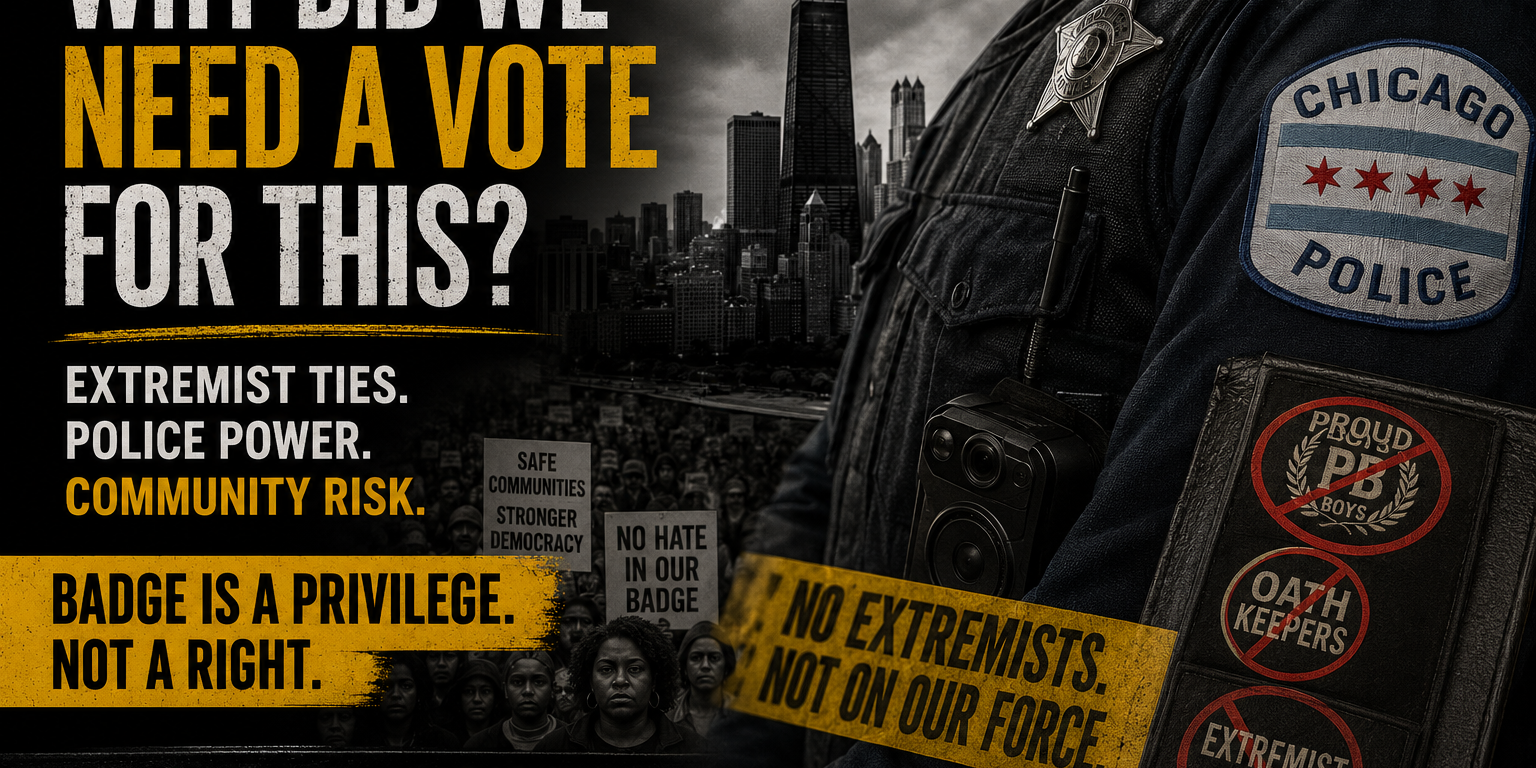
There are some stories that make you stop and ask one very simple question: why did we need a vote for this in the first place?
Chicago just moved to ban police officers with ties to extremist groups from serving in the Chicago Police Department, and yes, that is important. But let’s be honest. The fact that this even had to become an ordinance tells us something ugly about where we are.
Because why are people who believe in anti-democratic violence allowed to carry a badge?
Why are people connected to groups that want to overthrow the government allowed to enforce laws made by that same government?
Why are people tied to organizations that threaten civil rights allowed to police communities whose rights they may not even respect?
Why is this not already normal in every city, every county, and every state?
I do not mean normal as in “nice idea.” I mean normal as in basic public safety. Basic hiring standards. Basic common sense. Basic “we should not have to explain this to grown people with pensions and weapons.”
Chicago’s City Council voted 28-21 to approve an ordinance aimed at keeping officers with extremist ties out of CPD. The measure targets active participation in groups like the Proud Boys and Oath Keepers, groups whose members were connected to the January 6 attack on the U.S. Capitol. Earlier reporting from WBEZ said the proposal defined extremist activity as attempting to overthrow any level of U.S. government through violence or unconstitutional means, and it would give the Civilian Office of Police Accountability, not CPD’s internal unit, authority to investigate allegations involving extremist ties.
Read that slowly.
The ordinance is not saying officers cannot have political opinions. It is not saying officers cannot vote how they want, argue at Thanksgiving, complain about the mayor, or post something corny on Facebook.
It is saying if you are actively tied to groups that promote extremist violence, unconstitutional overthrow, or anti-democratic activity, maybe you should not have state power, a gun, qualified immunity, and the authority to decide who gets stopped, searched, arrested, believed, or brutalized.
Again, why is this controversial?
Because the vote was 28-21.
Not 49-0.
Not unanimous.
Not “of course, Day, because we are not insane.”
Twenty-one people voted no.
That is the part that should make everybody sit up a little straighter.
Because when the question is “should police officers be barred from active extremist activity?” and nearly half of a city council says no, the issue is bigger than one ordinance.
That is a mirror.
And baby, Chicago is not the only city that needs to look into it.
This is not about hating police. That is the lazy response people use when they do not want to deal with the actual issue. Every time communities ask for accountability, somebody jumps up and says, “Why do you hate officers?”
I do not hate officers.
I hate unaccountable power.
I hate double standards.
I hate people being given a badge while their beliefs tell them some communities are enemies.
I hate the idea that a person can be connected to extremist movements and still be trusted to make life-altering decisions over Black people, immigrants, protestors, LGBTQ people, Muslims, Jewish people, organizers, unhoused people, disabled people, and anyone else those movements might target.
That is not public safety.
That is a threat wearing a uniform.
Let’s say the quiet part out loud. Policing already comes with enormous power. Officers can stop you. They can detain you. They can search you. They can use force. They can write reports that judges and prosecutors may take seriously. They can decide whether your fear gets treated as reasonable or suspicious. They can decide whether your anger is seen as emotion or aggression.
So when someone with extremist ties holds that power, the harm is not theoretical.
It is not just about what they believe in private.
It is about how those beliefs may show up when they are making decisions in public.
It is about who they see as human.
It is about who they see as dangerous.
It is about who they think deserves protection and who they think deserves punishment.
It is about the community member who calls for help and ends up being treated like the problem.
It is about the protestor exercising constitutional rights while being policed by someone who may see dissent as something to crush.
It is about the Black teenager walking home.
It is about the immigrant father pulled over after work.
It is about the woman asking for help during a crisis.
It is about the person whose name, neighborhood, skin, language, religion, gender, or politics already makes them vulnerable to bias.
Now add an officer with extremist ties into that situation.
Exactly.
That is why people are asking hard questions.
And the questions are not radical. They are responsible.
Chicago has already seen warning signs. WBEZ reported that at least a dozen Chicago police officials had previously been investigated for alleged ties to the Oath Keepers and Proud Boys. The same report said Chicago’s inspector general had criticized the city’s handling of extremism in police ranks as having “fallen short.”
That matters.
Because this is not some imaginary fear people pulled out of the air.
This is not “what if.”
This is “we have already seen enough to know we need stronger rules.”
WBEZ and the Chicago Sun-Times previously reported that CPD had implemented rules intended to bar officers from joining far-right and anti-government organizations, but the department’s registry of “criminal and biased organizations” listed 675 gang factions and did not list groups that reporters had documented officers associating with, including the Ku Klux Klan, Proud Boys, and Oath Keepers.
So let me get this straight.
The department could maintain a long list of street gangs, but somehow extremist groups tied to anti-government violence and hate were not clearly named on that list?
That is the kind of detail that tells you the problem is not only bad actors.
The problem is systems that know how to look very hard in one direction and become suddenly blurry in another.
Because who gets labeled dangerous in America has always been political.
Black children get called threats.
Protestors get called mobs.
Immigrants get called criminals.
Muslims get called suspicious.
Poor people get called disorderly.
But let an officer be linked to certain extremist circles, and suddenly everybody wants nuance, patience, process, context, and seventeen rounds of “well, what do we really mean by extremist?”
No.
We know what we mean.
We mean people aligned with groups or activity that threaten democratic government, civil rights, and public safety.
We mean groups that recruit from police and military spaces because they understand the value of state power.
We mean people who should not be trusted with a badge if their outside loyalties undermine the rights of the people they are sworn to serve.
And yes, constitutional rights matter.
No one should lose a job simply for reading a book, having a controversial opinion, criticizing the government, or belonging to a lawful political organization.
That is not what this should be about.
But there is a difference between protected speech and active participation in extremist activity.
There is a difference between an opinion and organized intimidation.
There is a difference between private politics and movements tied to violence, anti-democratic action, or the stripping away of other people’s rights.
And if an officer cannot tell the difference, that officer should not be in a position where the public has to trust their judgment.
I keep coming back to the phrase “protect and serve.”
Because protect and serve who?
Everybody loves that slogan until you ask who gets protected and who gets surveilled.
Who gets served and who gets stopped.
Who gets grace and who gets force.
Who gets a wellness check and who gets handcuffs.
Who gets treated as a citizen and who gets treated as a target.
If someone believes certain people are less deserving of rights, safety, dignity, or democratic participation, how are they supposed to protect those people?
If someone is attracted to groups that glorify political violence, hierarchy, intimidation, or the overthrow of government, how are they supposed to fairly enforce the law?
If someone is comfortable standing with groups that threaten the communities they patrol, why should those communities be forced to accept that risk?
This is where the conversation gets real.
Police departments love to talk about public trust.
They hold press conferences about public trust.
They form committees about public trust.
They release statements about rebuilding public trust.
But public trust is not built with slogans.
Public trust is built when the public sees actual standards.
Public trust is built when communities know the person pulling them over is not tied to a group that sees them as an enemy.
Public trust is built when officers are held to the kind of scrutiny that matches the power they carry.
Public trust is built when the department does not investigate itself and then tell the public, “Do not worry, we handled it.”
That is another reason the Chicago ordinance matters. The proposal gives COPA, the Civilian Office of Police Accountability, power to investigate allegations involving extremist activity instead of keeping those complaints inside the department’s own internal process.
That is important.
Because when the same institution accused of tolerating the problem also gets to control the investigation, communities have every reason to question the outcome.
We have seen that movie.
We know how it ends.
A long investigation. A quiet finding. A carefully worded statement. A little suspension, maybe. A transfer, maybe. A “policy review.” A promise to do better. Then everybody moves on until the next scandal.
That is not accountability.
That is maintenance.
And communities are tired of watching systems maintain themselves.
Now, let me say this clearly: Chicago passing this ordinance does not mean the work is done.
Passing a rule is one thing.
Enforcing it is another.
We need transparency. We need real investigations. We need public reporting. We need hiring checks that actually mean something. We need discipline that is not watered down behind closed doors. We need standards that do not depend on whether the officer is popular, politically protected, or connected to the right union forces.
Because a rule without enforcement is just a press release with better grammar.
Still, this ordinance matters because it names something many cities are too afraid to name.
It says extremist ties in policing are not just a personnel issue.
They are a democracy issue.
They are a civil rights issue.
They are a safety issue.
They are a trust issue.
They are a “who gets to wear the badge” issue.
And that is why this should not be a Chicago-only conversation.
Every state should be asking this question.
Every police department should be asking this question.
Every mayor, governor, city council member, police board, sheriff’s office, state certification board, and public safety committee should be asking this question.
Do we have a policy that clearly bans active extremist participation by law enforcement?
Who investigates it?
Is the process independent?
Are applicants screened?
Are current officers reviewed?
Are complaints tracked?
Are the public results transparent?
Can officers be disciplined, fired, or decertified?
Are unions able to block accountability?
Are communities allowed to know whether the person policing them is connected to movements that threaten their rights?
Because if the answer is unclear, then the policy is not strong enough.
And if the answer is “we trust our officers,” that is not a policy.
That is a prayer.
I am not interested in prayers dressed up as public safety.
I want systems.
I want standards.
I want consequences.
I want communities protected from people who should never have been handed a badge in the first place.
Because let’s be honest, if a teacher had active ties to an extremist group, parents would be asking questions.
If a judge had active ties to an extremist group, people would question every ruling.
If a nurse had active ties to an extremist group targeting certain communities, patients would be terrified.
If a pilot had active ties to an extremist group that openly fantasized about violence, nobody would say, “Well, let’s not be unfair to pilots.”
So why do we keep acting like policing should be the exception?
Police officers are not less powerful than those professions.
They are more immediately dangerous when that power is abused.
That is why the standard should be higher, not lower.
And yes, some people will say, “But where do we draw the line?”
We draw the line at active participation in movements that threaten democracy, civil rights, and public safety.
We draw the line at violence.
We draw the line at unconstitutional overthrow.
We draw the line at recruiting, fundraising, organizing, displaying symbols, or materially supporting groups whose mission conflicts with the rights of the people officers swear to protect.
We draw the line before harm happens.
Because waiting until an officer with extremist ties hurts somebody is not neutrality.
It is negligence.
The main takeaway is simple.
Police officers do not have a right to public trust just because they put on a uniform.
They earn it through conduct, accountability, and standards that protect the community, not just the department.
And if someone wants to be connected to extremist groups, that is their choice.
But they do not also get to carry a badge and ask the public to pretend those beliefs stop at the locker room door.
They do not get to hold state power over the very people their ideology may target.
They do not get to hide behind “protect and serve” while aligning with movements that threaten democracy itself.
Chicago should not be treated as some radical outlier for passing this ordinance.
The real question is why every state has not already done the same.
Let’s Talk
Why do you think banning active extremist ties in policing is still treated like a controversial idea instead of a basic public safety standard? Drop your thoughts in the comments, because this is about who gets to carry power over our communities.