


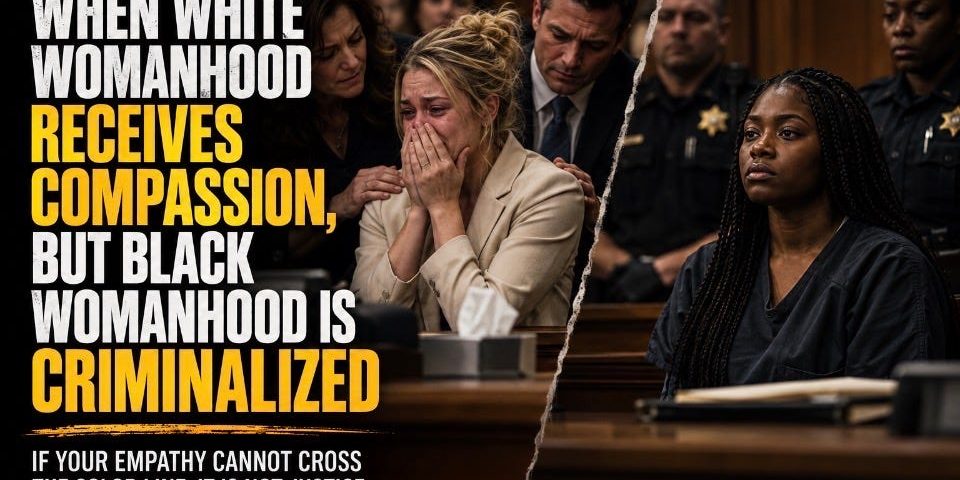
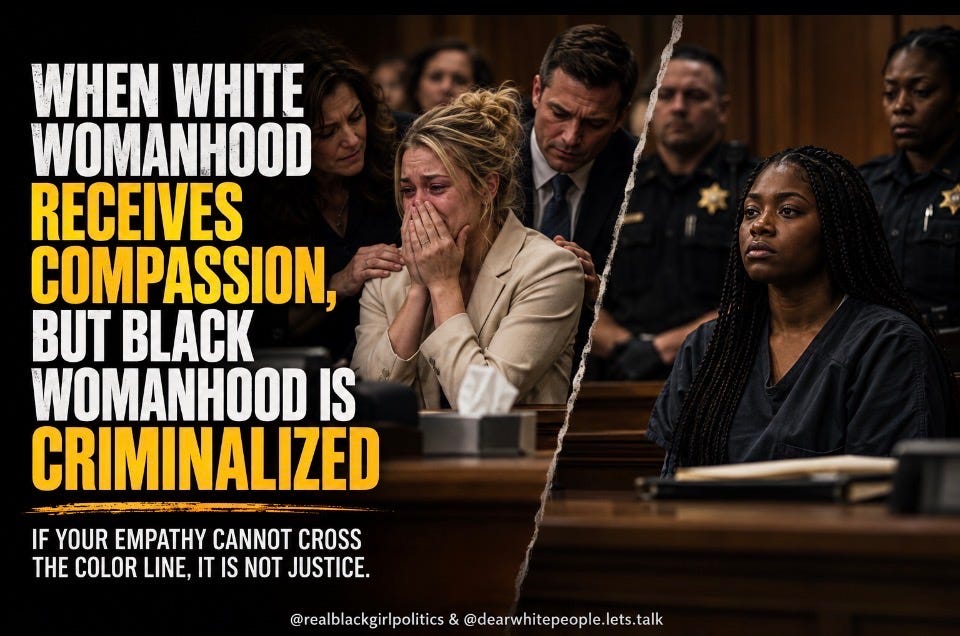
White women, sit down before you digest this.
And I mean that with the full love of truth and the full warning of discomfort.
Because this is not the kind of conversation where you get to skim, clutch your pearls, say “how sad,” and keep scrolling. This is the kind of conversation that asks you to look directly at the racial divide in public empathy and ask why your compassion seems to find white women so easily, but gets lost when a Black woman is standing right in front of you.
Lindsay Clancy’s case has drawn national attention. She is the Massachusetts mother accused of killing her three children in 2023. Her defense has argued that she was suffering from postpartum psychosis and should not be held criminally responsible. After a nearly six-week televised trial, the jury deadlocked and a judge declared a mistrial. She remains charged with murder and is expected to stay at a psychiatric hospital while the case continues.
Postpartum psychosis is real. It is severe. It deserves serious attention. Mothers deserve mental health care before a crisis becomes a tragedy. Families deserve systems that do not wait until the damage is irreversible before they pretend to care.
Let’s be very clear about that before anyone tries to derail the conversation.
This is not an article denying postpartum psychosis.
This is not an article saying Lindsay Clancy does not deserve compassion.
This is not an article asking people to dehumanize one woman so another woman can finally be seen.
That is not the point.
The point is that compassion in this country does not travel evenly.
And when white womanhood is in crisis, the world often knows exactly how to find tenderness.
When Black womanhood is in crisis, the world suddenly needs more proof.
Keshia Golden was eight months pregnant when she fatally stabbed Calvin Sidney in 2022. Her attorneys said she was acting in self-defense after a history of domestic violence. Reporting from WBEZ noted that police responded to five domestic violence incidents involving Golden and Sidney between June and September of 2022, and that in July 2022, Golden took out an order of protection after Sidney allegedly punched her in the face.
South Side Weekly reported that Golden’s public defenders said she had called police on Sidney at least 50 times before the night she stabbed him. She later accepted a last-minute plea deal for involuntary manslaughter, receiving two years of probation, community service, and drug testing, but no prison time. She still left court with a felony conviction.
So here is the question.
Where was the same urgency?
Where were the same hundreds of women rallying?
Where was the same national conversation?
Where was the same softness?
Where was the same insistence that a system had failed her before it punished her?
Where were the same white women who can organize compassion at lightning speed when the woman at the center looks like someone they recognize?
Because that is the part that keeps sitting heavy with me.
Hundreds of women rallied around Lindsay Clancy during her trial. WBUR reported that supporters showed up at the courthouse during the final weeks of testimony and said they believed the medical system failed her.
Again, postpartum mental health matters. Maternal mental health matters. I am not here to argue against compassion for a woman in psychiatric crisis.
I am asking why compassion has a race problem.
Because Keshia Golden was not asking the public to excuse the killing of children. She was a pregnant domestic violence survivor whose attorneys said she was defending herself and her unborn child. She had a history with police calls. She had an order of protection. She had documented abuse. She had the kind of facts people say they need before they believe a survivor.
And still, the support was not the same.
The outrage was not the same.
The protection was not the same.
The public imagination did not wrap itself around her with the same tenderness.
That matters.
These cases are not legally identical. That needs to be said clearly because people love to pretend that if two cases are not identical, there is nothing to compare.
Lindsay Clancy’s defense centers on severe mental illness and criminal responsibility. Her attorneys argued she was suffering from postpartum psychosis when her children were killed. Prosecutors argued she was criminally responsible. The jury could not reach a unanimous decision.
Keshia Golden’s case centered on self-defense and documented domestic violence. Her attorneys said Sidney slammed her into a counter and refrigerator after their baby shower, and that she stabbed him once in the leg while protecting herself and her unborn child. People reported that she pleaded guilty to involuntary manslaughter after initially facing the possibility of decades in prison.
Different facts.
Different legal defenses.
Different states.
Different courts.
Different charges.
Yes.
But the racial divide in public empathy is still impossible to ignore.
And that is the conversation too many people want to run from.
Because race does not have to be mentioned out loud to determine who receives compassion and who gets criminalized.
Race does not have to be written into the statute to shape who is believed.
Race does not have to appear in the headline for racial bias to shape the public response.
We know this.
We see it over and over again.
White women are more readily viewed as fragile, ill, overwhelmed, complicated, misunderstood, failed by systems, and deserving of grace.
Black women are more often viewed as dangerous, angry, responsible, unstable, aggressive, guilty, and undeserving of protection, even when they are documented survivors.
That is not an accident.
That is history.
That is the afterlife of stereotypes that have followed Black women for generations.
The angry Black woman.
The strong Black woman.
The aggressive Black woman.
The bad mother.
The woman who can take more pain.
The woman who does not need protecting.
The woman whose fear is not treated as reasonable.
The woman whose tears do not move the room.
The woman whose survival gets recast as violence.
And let me say that again: Black women’s survival is too often recast as violence.
When we defend ourselves, the system asks why we did not leave sooner.
When we call for help, the system asks why we went back.
When we report abuse, the system asks if we are credible.
When we fight back, the system asks why we did not just take it.
When we are afraid, the system asks if we are exaggerating.
When we are harmed, the system asks what we did to cause it.
And when a Black woman survives something that could have killed her, the system still finds a way to put her on trial.
That is why Keshia Golden’s case is not just about one plea deal.
It is about how this country treats Black women who survive violence.
It is about how quickly domestic violence becomes a side note when the survivor is Black.
It is about how protection orders and police calls can exist on paper, yet the public still struggles to see a Black woman as someone who needed protection.
It is about how Black women are expected to prove danger before they act, then punished for acting once danger arrives.
And if you are a white woman reading this, this is where the discomfort is supposed to start doing its job.
Not because you personally caused every unequal outcome in the legal system.
Not because you are responsible for solving everything by yourself.
But because white women have power in public sympathy.
White women know how to organize around a story.
White women know how to turn pain into a cause.
White women know how to rally, write letters, raise money, start groups, flood comment sections, contact reporters, show up in courtrooms, pressure institutions, and demand that the public see a woman’s humanity.
We have seen it.
So the question is not whether you can do it.
The question is why that power gets activated so unevenly.
Why does white womanhood get a movement, while Black womanhood gets a footnote?
Why does Lindsay become a symbol of a failed mental health system, while Keshia has to fight to even be seen as a survivor?
Why do some women get “what happened to her?” while others get “what did she do?”
That difference is not small.
That difference can shape public pressure.
That difference can shape headlines.
That difference can shape fundraising.
That difference can shape which cases get national attention and which ones stay local until Black women force people to look.
And no, public support does not decide every legal outcome. But public empathy does help determine which stories become urgent. It helps determine whose pain becomes a national conversation and whose pain gets treated as background noise.
That is why I keep asking where the same white women were.
Because if your feminism only knows how to protect women who look like you, it is not feminism. It is white solidarity.
White solidarity is what happens when white women gather around another white woman with instinctive protection, even when the facts are horrifying, while struggling to extend that same urgency to Black women harmed by systems, partners, police, courts, workplaces, hospitals, or public opinion.
White solidarity says, “She could be me,” when looking at Lindsay.
But when looking at Keshia, it becomes quiet.
White solidarity can find compassion for a white mother accused in the deaths of her children, but somehow cannot find the same urgency for a pregnant Black woman who said she was defending herself from a man with a documented history of abuse.
That is the problem.
And I know some people will say, “But I just heard about Keshia’s case.”
Exactly.
Why?
Why did you hear so much about Lindsay, but not Keshia?
Why did one case reach you through national obsession, courthouse support, livestreamed legal analysis, and endless commentary, while the other required Black people and local organizers to keep saying her name?
That gap is not neutral.
That gap is part of the system.
Media attention is not evenly distributed.
Public compassion is not evenly distributed.
Fundraising energy is not evenly distributed.
The presumption of humanity is not evenly distributed.
And white women need to stop pretending they do not benefit from that unevenness.
This is not about removing compassion from Lindsay Clancy.
It is about asking why Keshia Golden had to fight so hard to receive even a fraction of it.
It is about asking why Black women’s trauma is treated like evidence to be cross-examined, while white women’s trauma is treated like context.
It is about asking why white womanhood is allowed to be complicated, but Black womanhood is forced to be perfect.
Because that is what it often comes down to.
White women can be fragile and dangerous.
White women can be sick and still human.
White women can be overwhelmed and still worthy of study.
White women can be failed by systems and still deserving of care.
But Black women are expected to be flawless before anyone considers us worthy of protection.
A Black woman cannot have a messy history.
A Black woman cannot be imperfect.
A Black woman cannot be scared and angry.
A Black woman cannot have made choices under pressure.
A Black woman cannot be exhausted.
A Black woman cannot respond to violence in a way the public finds uncomfortable.
A Black woman has to be the perfect victim, and even then, people still ask for more proof.
That is why this comparison matters.
Not because the cases are legally identical.
Because the empathy is not.
And the empathy tells on us.
It tells us who gets imagined as a mother.
It tells us who gets imagined as mentally unwell.
It tells us who gets imagined as a survivor.
It tells us who gets imagined as a threat.
It tells us who gets imagined as redeemable.
It tells us who gets imagined as deserving a future.
Keshia Golden received probation, and I am glad she is not going to prison. But let’s not pretend probation erases what she carried. She faced the possibility of decades behind bars. She had to accept a felony conviction. She had to move through the terror of a system that could have separated her from her child for years.
That matters.
And it should have mattered to more people sooner.
Because Black women should not have to be on the edge of being swallowed by the legal system before the public starts asking whether they deserve compassion.
Black women should not have to beg for people to believe documented harm.
Black women should not have to watch white women receive organized tenderness while they receive legal suspicion.
Black women should not have to be perfect to be protected.
The main takeaway is simple.
The question is not whether Lindsay Clancy deserves compassion.
The question is why compassion keeps stopping at the color line.
The question is why so many white women can show up loudly for white womanhood in crisis, but go silent when a Black mother needs them.
The question is why postpartum psychosis can become a national conversation, but Black maternal survival, domestic violence, self-defense, and criminalization struggle to receive the same urgency.
The question is why white pain gets system analysis, while Black pain gets judgment.
That is what we need to talk about.
Because if your empathy cannot cross the color line, it is not justice.
It is preference.
And if your feminism cannot see Keshia Golden with the same urgency it sees Lindsay Clancy, then your feminism is not about women.
It is about whiteness.
Let’s Talk
Where do you see the racial divide in public empathy show up the most: criminal cases, domestic violence, motherhood, mental health, media coverage, or everyday conversations? Drop your thoughts in the comments, because this conversation needs honesty, not comfort.
Thanks for reading. If this piece moved you or made you think, please consider becoming a subscriber.
Learn more about me: www.iamdaymadison.com
To go deeper in this work, join our Anti-Racism Book Club for White Women, where we move beyond surface-level allyship and into real education, accountability, and accomplice work.
Learn more here: https://bookclubs.com/anti-racism-book-club-13/join/
Follow my social media pages:
Instagram: @dearwhitepeople.lets.talk, @blackgirlonracism, and @realblackgirlpolitics
TikTok: @blackgirlpolitics